Stroll Through Le Marais
Le Marais is one of Paris’s oldest districts, but don’t let “old” fool you. It’s buzzing with energy — a neighborhood where medieval streets twist into trendy boutiques, Jewish bakeries, and art galleries. The area managed to escape Haussmann’s sweeping renovations in the 19th century, which means its crooked little lanes still feel like stepping back in time.
Start at Place des Vosges, Paris’s oldest planned square, a perfect rectangle surrounded by red-brick mansions with arched walkways. Grab a bench under the trees, watch kids chase pigeons, and let time slow down. From there, you can explore streets like Rue des Rosiers for falafel (arguably the best in Europe) or dip into small museums like the Musée Carnavalet, which tells the story of Paris itself.
It’s Paris stripped of gloss — historic, lived-in, and alive with texture.
Canal Saint-Martin: Picnic by the Water
Forget the Seine for a moment. Head northeast and you’ll find the Canal Saint-Martin, a narrow waterway lined with iron footbridges and hip cafés. On sunny days, locals spread out picnics on the banks: baguettes, bottles of wine, cheese wrapped in paper. It feels casual, unpretentious — the opposite of the tourist-packed river cruises.
In the evenings, the vibe shifts. Young Parisians cluster with guitars, people laugh loudly over beers, and the canal becomes more like an open-air living room than a sightseeing stop.
If you want a slow afternoon, pick up a sandwich from a bakery, sit by the water, and watch boats move through the old locks. It’s Paris, but with sneakers instead of stilettos.
Montmartre Beyond the Crowds
Everyone knows Montmartre for Sacré-Cœur, and yes, it’s worth the climb. But here’s the secret: once you’ve seen the basilica, keep walking away from the tourist swarm.
Wander into the side streets and you’ll find cobblestones, ivy-draped houses, and old lampposts that feel more like a village than a capital city. Look for Rue de l’Abreuvoir, one of the prettiest streets in all of Paris, where the pink façade of La Maison Rose café looks like something out of a painting (which, in fact, it has been — Picasso and Renoir both hung around here).
If you’re lucky, you might stumble on the tiny Vineyard of Montmartre — yes, Paris still makes its own wine in this neighborhood. It’s quirky, charming, and feels like stepping out of time.
Dive Into Book Heaven at Shakespeare and Company
On the Left Bank, just across from Notre-Dame, sits a bookstore that feels more like a time capsule than a shop. Shakespeare and Company has been a gathering spot for writers, poets, and dreamers since the 1950s. Its creaky wooden stairs lead to reading nooks where you can lose hours.
The store famously lets writers sleep among the stacks in exchange for helping out — thousands of aspiring authors have done so over the years. Even if you’re not staying the night, flipping through a book here feels different. You’re not just buying a novel; you’re stepping into a living tradition of Paris as a city of stories.
Museums Without the Overload
Yes, the Louvre is incredible. It’s also massive, overwhelming, and usually packed shoulder-to-shoulder. If you want art without exhaustion, Paris has dozens of smaller museums that are just as rich.
Musée de l’Orangerie — Home to Monet’s water lilies, displayed in oval rooms designed to make you feel like you’re floating inside the paintings. Small, manageable, unforgettable.
Musée Rodin — A mansion filled with Rodin’s sculptures, plus gardens where The Thinker and The Gates of Hell sit in the open air. On a sunny day, it’s pure magic.
Musée Marmottan Monet — Tucked away in the 16th arrondissement, it holds the largest collection of Monet’s works anywhere. Way less crowded, way more intimate.
These places remind you that art isn’t just something you look at once and cross off a list — it’s something to soak in slowly.
The Markets of Paris
One of the best ways to feel the city’s rhythm is through its markets. Paris is dotted with them, each with its own character.
Marché d’Aligre — A mix of open-air stalls and a covered market, selling everything from cheeses and spices to antiques and flowers.
Marché Bastille — Huge, lively, with fresh produce, seafood, and street food. Come hungry.
Marché aux Puces de Saint-Ouen — The city’s most famous flea market, where you can dig through endless vintage treasures.
Markets are noisy, colorful, and unpolished — a perfect break from quiet museums or polished boulevards.
Green Escapes
Paris can be intense, but it also knows how to breathe. The city’s parks are not just green spaces, they’re social theaters.
Jardin du Luxembourg — Students reading, kids sailing toy boats in the fountain, couples strolling hand-in-hand. It’s classic Paris.
Parc des Buttes-Chaumont — Wild and hilly, with waterfalls, caves, and a temple perched on a cliff. Far less formal, far more adventurous.
Promenade Plantée (Coulée Verte) — An elevated walkway built on an old railway line, lined with gardens and views. It inspired New York’s High Line.
Even in a city of stone and steel, Paris makes room for nature.
Eat Where the Locals Do
The Eiffel Tower has restaurants, but you’ll pay sky-high prices for mediocre food. Paris is full of better (and cheaper) bites if you know where to look.
Grab a crêpe from a street stand near Montparnasse. Simple, buttery, and perfect.
Pop into a boulangerie in the morning for a croissant that flakes all over your jacket.
Try a tiny bistro with chalkboard menus that change daily. That’s where the heart of Parisian food lives.
And don’t skip the wine bars — small, noisy, full of locals debating politics over glasses of red.
Food here isn’t just eating; it’s culture on a plate.
Nighttime Paris Without the Tower Lights
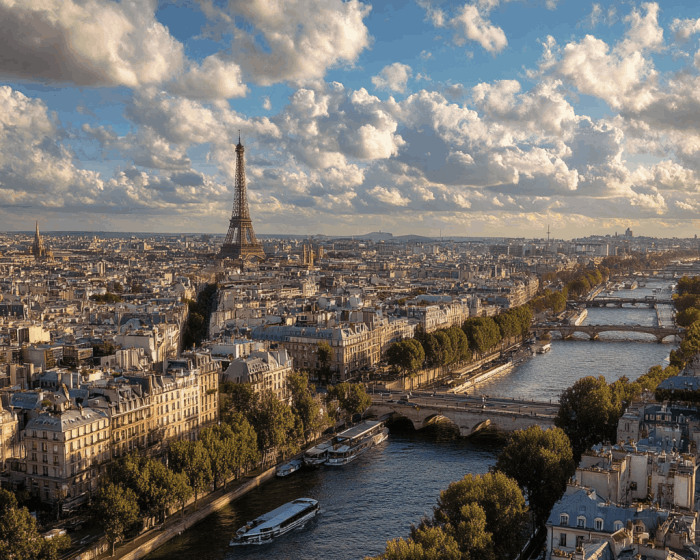
Sure, the Eiffel Tower sparkles at night. But Paris after dark has plenty more glow.
Head to the Latin Quarter for narrow streets buzzing with cafés, music, and late-night conversations. Walk along the Seine when the bookstalls close and the city lights ripple on the water. Or find a jazz club — Paris has a long love affair with jazz, and hearing it live in a cellar bar feels timeless.
This is the city of light not just because of one tower, but because it seems to shimmer from every corner.